Construction AI / Devfum Vertical
AI systems for construction workflows where accuracy has to be reviewable.
Devfum builds construction AI tools for plan sets, takeoff workflows, scope creation, and document-heavy preconstruction operations — with human review, source traceability, and production-readiness built into the workflow.
CDAP / Product Preview
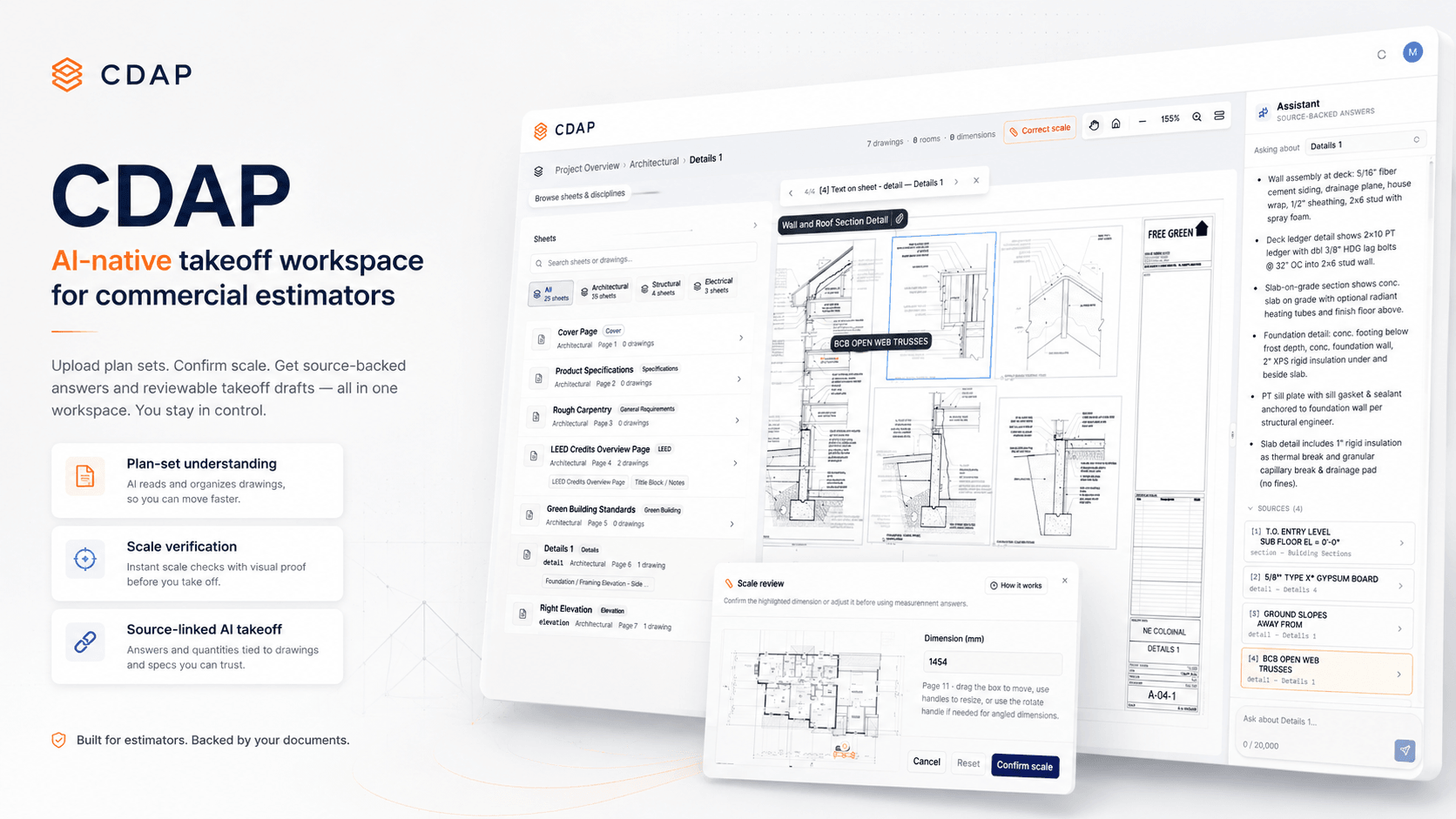
01 / Document AI
Plan-set upload, sheet classification, discipline detection, and drawing context extraction.
02 / Takeoff R&D
AI-assisted architectural QTO — areas, lines, counts, and room-linked quantities from drawings.
03 / Scope Automation
SOW generation from inspection recordings, structured findings, and specification formatting.
04 / Review Workflows
Estimator-controlled approval, source-linked traceability, and export-only-after-review rules.
Product Launch / CDAP
Construction Document Analysis Platform
An AI-native takeoff workspace for commercial GC estimators.
CDAP helps estimators move from uploaded plans to reviewable architectural QTO drafts. The system is designed around traceability: quantities link back to drawings, assumptions are separated from facts, and exports only happen after estimator review.
CDAP Launch Window
Final launch checks are underway. The CDAP workspace goes live when the countdown reaches zero.
How CDAP works
A source-backed workspace for construction plan sets, not a black-box quantity generator.
Upload a plan set
Create a project and upload construction PDFs. CDAP organizes sheets by discipline and relevance.
Confirm scale and context
Verify drawing scale, sheet metadata, and assumptions before generating quantity outputs.
Generate and review QTO draft
Draft quantities with source links, then inspect evidence directly on the drawing.
Approve before export
Edit, approve, reject, or exclude quantities. Only reviewed outputs can be exported.
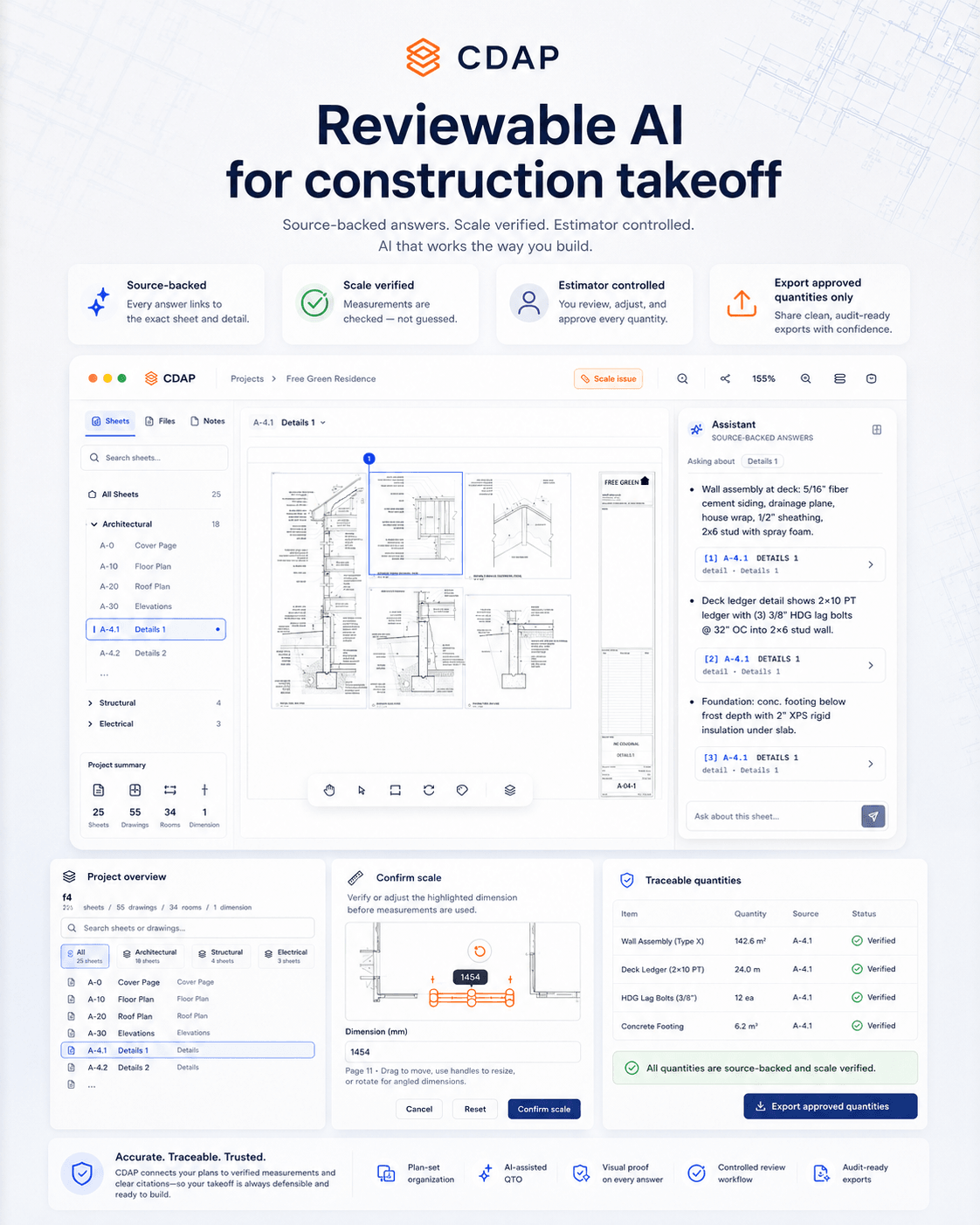
Review system
- Source-linked quantities per sheet
- Facts vs assumptions visible in context
- Estimator approval before export
01 / Plan Sets
Plan-set upload
Upload construction PDFs and plan sets. The system ingests, parses, and prepares documents for analysis.
02 / Organization
Sheet organization
Sheets are classified by discipline and relevance — architectural, structural, irrelevant — with revision awareness.
03 / Calibration
Scale confirmation
Detect and verify drawing scale before quantity extraction. Incorrect scale invalidates everything downstream.
04 / AI Draft
AI-assisted QTO draft
Generate architectural quantity drafts — areas, lengths, counts — linked to specific sheets and drawing regions.
05 / Traceability
Visual proof overlay
Every quantity links back to a source drawing. Click a number to see where it came from on the plan.
06 / Control
Review, approve, export
Estimators review each quantity — approve, edit, reject, or exclude. Only reviewed quantities reach export.
Domain Problem
Construction AI fails when it cannot show its work.
Estimators do not trust black-box quantities. In real preconstruction workflows, scale, sheet references, legends, schedules, callouts, and revisions all affect whether an output can be used. CDAP is built around reviewability instead of blind automation.
Scale is a trust gate
One wrong scale makes the entire takeoff unusable. Scale must be verified before any quantity extraction.
Sheet references matter
Quantities without sheet context are unverifiable. Every output needs to link back to a specific drawing.
Revisions and addenda change scope
Plan sets are not static. AI output must account for revisions, superseded sheets, and addenda.
AI output must be editable
Estimators need to correct, adjust, and override. Read-only AI output has no place in real workflows.
Final approval belongs to the estimator
No quantity should reach export without human review. The estimator signs off, not the model.
Workflow Premise
Construction AI only becomes useful when document analysis, traceability, and estimator review are treated as one system.
R&D Tracks
From construction documents to controlled AI workflows.
01 / R&D
Plan-set understanding
Organizing drawings, identifying relevant sheets, extracting sheet context, and preparing documents before takeoff.
02 / R&D
Drawing intelligence
Experiments around drawing detection, room/region understanding, grids, and construction-specific visual extraction.
03 / R&D
Architectural QTO
Drafting quantities for areas, lines, counts, and room/sheet-linked architectural scopes.
04 / R&D
Source-backed AI assistant
Project-level assistant behavior that answers from uploaded documents and separates facts from assumptions.
05 / R&D
Review and export workflow
Quantity tables, review statuses, corrections, approvals, and export rules for estimator-controlled output.
Related Construction Work
Client work that shaped the construction AI vertical.
Operating Philosophy
The estimator stays in control.
01
AI drafts, humans approve
The model generates quantities. The estimator decides what ships.
02
Every quantity needs a source
No number without a drawing reference. Traceability is non-negotiable.
03
Uncertainty must be visible
Assumptions are flagged. Facts are sourced. The estimator sees the difference.
04
Export only reviewed work
Nothing leaves the system without explicit estimator approval.
Book a Consultation

Talk construction AI with Zohair.
Book a focused call about CDAP, plan-set intelligence, takeoff workflows, or custom construction document automation. Zohair leads Devfum's AI conversations for construction and document-heavy products.
Good for discussing
- CDAP / architectural QTO workflows
- Plan-set AI and takeoff automation
- Document intelligence for preconstruction
- Custom construction AI builds
Loading calendar...
Powered by Calendly
Open in new tab →Get in touch
Working on construction documents, takeoff, or preconstruction automation?
Book a consultation with Zohair about construction AI systems, CDAP, or custom workflow automation for document-heavy construction operations.